Why Your Wood Screws Keep Failing (And It's Not About Quality)
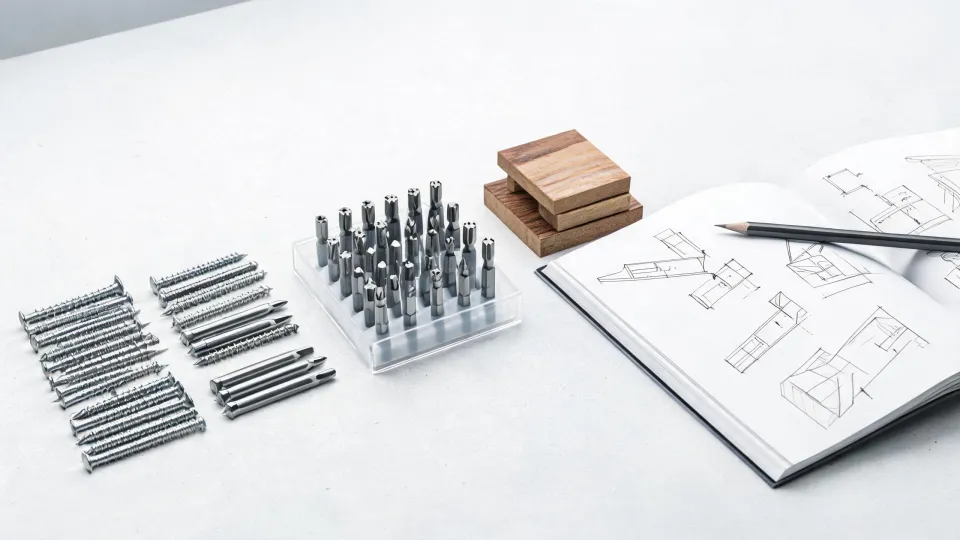
Every so often, I get a call from a contractor who's about to toss a box of screws across the yard. The story is basically always the same: they're driving into dense oak or MDF, the bit walks, the head strips, and the fastener snaps off. They're convinced the screw is garbage. As someone who reviews fasteners for a living—roughly 200 unique products a year—I keep telling people the same thing: most of the time, it's not the screw.
From the outside, a stripped head looks like a manufacturing defect. The reality is that most returned-product claims we see turn out to contain products within spec. The problem is the application. People assume all wood screws are the same, that the metal is the only difference. What they don't see is how thread angle, point design, and drive system affect performance in different materials.
The Real Problem Is a Spec Mismatch, Not the Product
Grab a general-purpose wood screw and drive it into a piece of hardwood. You might get lucky if you pre-drill and keep the drill speed down. Try the same screw in MDF or engineered lumber, though, and you're asking for trouble. MDF is dense, abrasive, and doesn't grip like solid wood. The screw fights you from the moment it makes contact, and eventually something has to give—the bit, the head, or the shank.
That's why industry standards matter. ASTM F1667 classifies wood screws by head type, point type, material, and finish. If you pick a screw that matches the material you're using, most of your headaches disappear. If you don't, you're essentially using a tool for the wrong job. SPAX, for example, makes a dedicated MDF screw line—the spax-m MDF screws—because MDF's internal structure is different enough that a general-purpose wood screw won't grip as well.
Here's something people don't always realize: cheap screws aren't necessarily weak—they're just less consistent. In our inspection, we reject batches for uneven plating, shallow drive depth, or skipped threads. That's part of why a brand like SPAX costs more; you're paying for tighter controls. But even the most consistent screw will fail if you put it in the wrong place or drive it the wrong way.
The Fastener World Has Changed (Even If Your Habits Haven't)
This is the part that surprises a lot of experienced contractors. The category moved on without them. If you learned the trade in 2005, pre-drilling was the rule, Phillips drivers caused cam-out all the time, and your screw choices were basically 'zinc' or 'stainless'. Then Torx drives and wafer heads showed up. Better torque transfer, less slipping, and some screws today are designed to eliminate the pre-drill step across a range of materials.
What was best practice in 2005 isn't the baseline anymore. The fundamentals of anchoring haven't changed—you still need adequate depth, proper diameter, and correct placement. But the execution has transformed. Modern multi-material screws like SPAX wood screws are engineered with aggressive threads and self-tapping points that bite into everything from deck lumber to hardwood and MDF. That's not hype; it's a direct result of thread geometry and drive design. Still, you have to choose the right variant for the job.
People often ask me if I think they should switch brands. I don't care which brand you use—I care that you read the label and match it to the material. SPAX happens to be a good example of how far the category has come, not the only one.
Actually, I should add: I've rejected batches from every major manufacturer when the spec is off. Nobody's perfect. The difference is how quickly they fix it. If you're still using the same screws and methods from 2010, you're leaving time and reliability on the table.
Installation Technique Is Part of the Equation
Another overlooked factor is how you drive the screw. I've watched a carpenter hammer an impact driver at full speed, in one burst, through hardwood. That's like trying to cut a 2x4 with one pass of a saw and wondering why the blade burns. Most screw specs list a recommended RPM and torque. Exceed the limit and you'll strip the head, twist the shank, or seat the screw so deep that it damages the material.
What a Wrong-Screw Fail Actually Costs
A stripped screw is more than a piece of scrap. To fix it, you have to drill it out, replace the board, or shift the fastener. On a 50-board deck, that can turn a one-day job into a two-day job. The material goes to waste, labor hours pile up, and your client watches you work around a mistake you could have avoided.
Numbers stick in my head. In Q1 2024, we audited a regional crew's returns. Of the screws they sent back as defective, 41% turned out to be perfectly within spec. The failures were from using the wrong screw type for the material. That one mismatch cost them nearly $2,000 in extra labor and replacement lumber before we traced the pattern. The screw wasn't the problem—the habit was.
I also remember a production run where a spec mix-up gave us a 304 stainless screw in a 410 packaging line. We caught it during inspection and rejected 8,000 units. That's the kind of issue that quality protocols exist for. But for most users, the issue is much simpler: a habit carried over from an old job or an old tool.
And don't overlook moisture. Wood expands and contracts. Use a screw that isn't rated for exterior or wet environments and corrosion sets in, eating the screw from the inside out. The failure looks like a broken fastener, but it's actually a selection failure—you picked the wrong material for the environment.
The Fix: Match the Screw to the Application
So what should you do differently? Three things:
- Read the spec. Look at the material you're fastening and the manufacturer's recommendation. If you're working with MDF, pick a screw designed for MDF, like the spax-m. For structural connections, use a rated structural screw—not a general decking screw.
- Use the right driver. A Torx bit that seats fully is the single easiest way to eliminate cam-out. Toss the worn-out Phillips bit and stop fighting the drive system.
- Test before you commit. Drive one screw into a scrap piece of the actual material. If it behaves, continue. If not, change the screw or your method before you touch the job piece.
If you're still not confident, call the manufacturer's technical support. I know that sounds old-school, but it works. I've spoken with contractors who stood in the aisle of a home center and called a 1-800 number before buying. That's the smart way to shop fasteners.
That's the same logic you use with any tool in your box. You wouldn't ask 'what size hydraulic jack do I need' and just grab the biggest one—you'd check the rating. You wouldn't buy a master mechanic tool set and expect every wrench to fit every bolt. And you wouldn't use a 0.9 cu ft portable washer to wash a whole fleet; it's a tool for a specific job. Fasteners work the same way. Match the fastener to the material, load, and environment.
There's something satisfying about a deck that goes together without a single stripped head—especially after you've been fighting cam-outs all week. That satisfaction comes from respecting the spec instead of blaming the part.
Bottom line: most screw failures are failure to choose, not failure of the part. Modern fastener lines like SPAX wood screws, spax-m for MDF, and Powerlags for structural work have genuinely closed gaps that used to make pre-drilling mandatory. But they still need you to pick the right line. Do that, and you'll save time, money, and your reputation.

Maren Jorgensen
Maren Jorgensen is an independent hand tool and torque applications analyst covering wrenches, pliers, screwdrivers, hammers, sockets, ratchets, hex keys, and tool sets. She applies ISO 6789-1 torque-tool conformance principles while examining jaw capacity, leverage, fastener engagement, torque range, accuracy, handle geometry, and material hardness. Her practical guides help tradespeople and procurement teams select suitable tools, plan controlled tightening, and compare durability without relying on brand reputation alone.