What Are the Best Brands for Cabinet Hardware? A Quality Inspector's Fastener-First Take
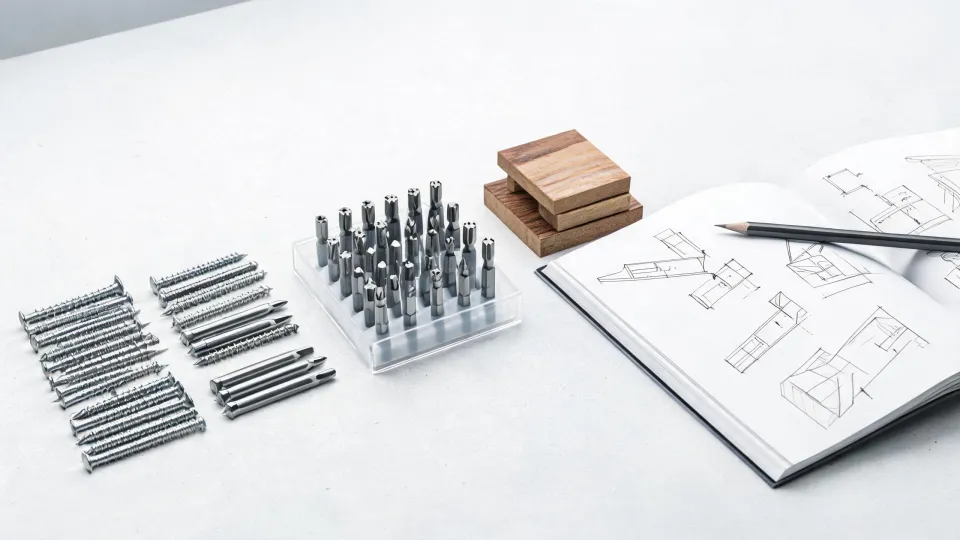
Let me start with a confession. I review fasteners for a living. I am a quality/compliance lead at a regional distributor, which means roughly 200 SKUs cross my inspection table every month. I rejected 11% of first deliveries in 2025. The reasons were rarely visible in a product photo: thread pitch, drive recess depth, barrel-nut length, packaging documentation.
Real talk: if your search phrase is what are the best brands for cabinet hardware, you are asking a consumer question. I would rather help you ask a builder question. Which hardware and fasteners are best for the material, drive system, and construction deadline in front of you? In my opinion, that second question is where jobs get won or lost.
Two ways to choose cabinet hardware
In my QA files, most installation problems come from one of two approaches. The first is finish-first: pick a hinge and handle by style, finish, and price, then use whatever screws shipped with the hardware. The second is fastener-first: pick hardware for appearance and function, but give screws, barrel nuts, anchors, and drivers their own seat at the table.
To be fair, the finish-first approach works fairly often. Most cabinet hardware includes adequate screws for a simple face-frame installation. But my callback pattern is consistent: a nice plate held by a stripped screw, a hinge screw that splits a cabinet side, or a cam connector that pulls loose because someone swapped the specified barrel nut for a look-alike.
Dimension 1: The fastener-substrate match
It is tempting to think one box of screws solves every cabinet job. That oversimplification is exactly why I inspect so many substrate failures. A coarse screw that works in 3/4-inch plywood can tear the surface out of dense MDF. The reverse is also true: a trim-head screw that excels in MDF can lack the bearing surface for a structural wood joint.
When the substrate is MDF, particleboard, or cabinet-grade composite, I usually approve the SPAX T20 Plus trim head zinc MDF cabinet screw. The trim head lets you mount hinges and hardware without adding a bulky washer profile, and the screw is engineered for the way composite boards hold threads.
When the connection is wood-to-wood framing or something load-bearing, I move to the SPAX T-20+ wafer head construction screws. The wafer head gives you broad bearing, and the T-20+ drive keeps the bit in the recess under torque. In my opinion, brand value shows up here: tolerance consistency across a whole box, not just the first screw.
Dimension 2: Drive consistency and the small spec that stops production
I have a simple test when I receive screws: seat a known-good bit in the recess and look at side-to-side movement. If the bit rocks, the lot is suspect. I used to think that was too picky. They warned me about cheap bits. I did not listen. The first sample looked fine. Then, after perhaps 2,000 units into cabinet assembly, the driver bit kept popping out. It stripped several screw heads. That cost more than the extra price of a higher-tolerance screw lot.
The same rule applies to connectors. If the drawing calls for a 1/4-in x 3/4-in plain steel barrel nut, I do not substitute a zinc one because the thread is similar. Material, barrel length, and cross-hole position affect clamping force and reassembly life. A cabinet hardware brand with a beautiful finish will not fix a connector spec that is wrong.
Dimension 3: Time certainty and tools
Look, I am not going to tell you that quality inspection is exciting. But certainty under a deadline is valuable. In my opinion, a rush delivery fee buys certainty, not just speed. In September 2025, a contractor needed a replacement order of cabinet screws for a Friday install. The alternative was a cheaper screw from another city that would arrive maybe Thursday. Maybe. They paid more for guaranteed delivery and finished on schedule. I have been on the other side. The uncertain cheap option becomes more expensive only after you see a crew standing still.
Certainty also comes from the tool side. If the job requires mounting cabinets to concrete block or masonry, a drill/driver in hammer mode is not a reliable plan. A rotary hammer or SDS drill is the right class of tool. On installs I spec, the DCH263B 20V Max SDS Plus rotary hammer is often listed because it makes clean anchor holes with less vibration and user pressure. The fastener cannot do its job if the hole wanders.
So which brands are best for cabinet hardware?
Here is my most honest quality answer: I do not believe in a universal best handle or hinge brand. I believe in a short list for a defined job. The best hardware brand is one whose dimensions match your application, whose screws meet the substrate, and whose packaging gives you confidence before installation.
- For MDF and particleboard cabinet panels, start with the SPAX T20 Plus trim head zinc MDF cabinet screw.
- For wood-to-wood framing and structural blocking, use SPAX T-20+ wafer head construction screws.
- For ready-to-assemble cabinet connections, verify the exact 1/4-in x 3/4-in plain steel barrel nut specification before you approve the lot.
- For masonry or concrete mounting, keep a DCH263B 20V Max SDS Plus rotary hammer on the tool schedule, or an equivalent SDS Plus rotary hammer.
Ask what are the best brands for cabinet hardware and you will get lists. Ask instead what your substrate, drive, connector, and deadline require. That is a question quality work can answer.

Maren Jorgensen
Maren Jorgensen is an independent hand tool and torque applications analyst covering wrenches, pliers, screwdrivers, hammers, sockets, ratchets, hex keys, and tool sets. She applies ISO 6789-1 torque-tool conformance principles while examining jaw capacity, leverage, fastener engagement, torque range, accuracy, handle geometry, and material hardness. Her practical guides help tradespeople and procurement teams select suitable tools, plan controlled tightening, and compare durability without relying on brand reputation alone.