The $1,400 Decking Order That Taught Me to Stop Guessing on Fasteners
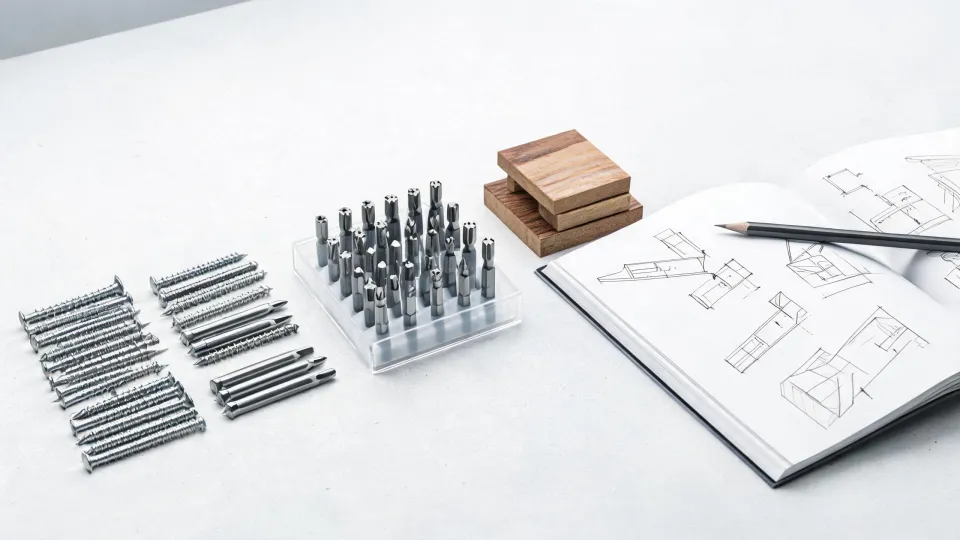
If your order mixes MDF panels, treated lumber, and structural connections in the same week, then stop treating SPAX screws, an 8mm zinc-plated fine thread hex bolt, and a box of #10 screws as interchangeable stock. They are not. Thirty minutes verifying thread pitch, drive type, and coating before you place the order is cheaper than three days of rework after it ships.
Buying the wrong fastener has never cost me just the hardware. It cost me a redo, a delayed inspection, and a client who started wondering if I knew what I was doing. Over seven years I've burned roughly $4,200 on "close enough" fastener orders. The checklist I now keep for my team is the direct scar tissue from those mistakes.
Why I'm Qualified to Talk About This (Unfortunately)
I handle construction fastening orders — wood, decking, MDF cabinetry, occasional structural work. Seven years in. I've kept a running tally: six significant mistakes totaling about $4,200 in wasted budget. The first one hit in 2019, when I thought "multi-material screw" was marketing fluff.
When I first started buying fasteners, I assumed any pointed screw with aggressive threads would work in any wood. SPAX called itself multi-material, and I mentally filed that under "nice claim, probably exaggerated." Then I ran a batch of MDF cabinet sides with the wrong pitch. 36 blown-out holes. The client needed delivery in four days. That one cost me about $600 and a week of embarrassment.
That was round one. There were more.
The Decking Order That Made Me Take Pre-Drilling Seriously
September 2022: I ordered roughly $2,300 of composite-and-treated decking screws — #10 screws, no pre-drill, wood joists. I figured it was fine because the substrate "looked soft enough." It wasn't. The deck squeaked. Screws cracked through the composite near the edges. The client asked for the whole surface pulled and redone. That single decision became about $1,400 in rework.
Here's what I learned the hard way: SPAX decking screws exist as a specific product line for a reason — a wafer head that prevents pull-through, coarse threads tuned for treated lumber and composite, and a coating that survives outdoor exposure. I'd been treating them as an expensive substitute for generic screws. They aren't. They're the low-cost option compared to doing the deck twice.
The 8-Point Pre-Order Checklist I Now Run
This is the list. Eight items. In the past 18 months, it's caught roughly 40 potential errors across our team, which I'd guess saved us around $3,000 in rework and one very awkward client call.
- Substrate. MDF vs. solid wood vs. composite vs. treated lumber. A SPAX MDF screw is not a SPAX decking screw. They do not swap.
- Thread pitch and type. Fine thread for dense materials or metal fastening; coarse for softwood and composite. This is the single biggest source of my past mistakes.
- Drive type. Torx, wafer, Phillips. Cam-out risk alone justifies picking the right one. If you've ever stripped a head at the top of a ladder, you know the feeling.
- Head style. Countersunk vs. pan head — this matters more than people think for flush finish.
- Coating. Zinc-plated is fine indoors. Outdoor means hot-dip galvanized or a proprietary SPAX coating. Don't substitute.
- Metric vs. imperial cross-check. An 8mm zinc-plated fine thread hex bolt is roughly 5/16" — close to a #10 screw in some contexts, but not the same part. Verify before you commit.
- Quantity buffer. Order 10% extra. You will drop some. You will also bend some.
- Cabinet hardware finish. This last one is the sneaky one. If your pulls don't match your screw head plating, the client notices.
Cabinet Hardware Finish Deserves Its Own Section
Q1 2024: a 60-unit cabinet order. All pulls brushed nickel. Screws bright zinc. Nobody flagged it — until the installer noticed on unit 12. Fixing it cost us two days and a hardware swap. About $450 plus delay, on a job that was otherwise on schedule.
How I choose cabinet hardware finish now: pick it at the same time I pick the screw coating, not after. Brushed nickel pairs with matte finishes. Polished chrome pairs with bright zinc. Brass pairs with brass. Sounds fussy. Isn't, if your client is a designer and you just "picked something."
Quick Note on the Structural Side
If you're doing anything load-rated — ledger board attachments, joist hangers, beam connections — the wrong spec is a liability, not an inconvenience. SPAX Powerlags are designed for that use case. They are not the same animal as a general-purpose 8mm hex bolt, and I think most of the mistakes I see now come from mixing structural-grade and utility-grade hardware in the same order.
One more thing. SPAX specs are printed clearly, and the wafer head drives cleanly, but the packaging doesn't remind you that "no pre-drill needed" only applies within a certain material thickness range. Past that range, you pre-drill. I learned that in 2023 when a batch of 1-inch MDF panels split clean through.
When This Doesn't Apply
Honestly? If your job is small — a single shelf, one SPAX screw pack — skip the full list. Five minutes of checking is overhead you don't need for a 10-screw fix.
The checklist also matters less when you've standardized on one supplier and one spec. Standardization cuts decisions, and that's a good thing.
But the moment an order mixes substrates, coatings, or a client-specified finish, do not skip it. Five minutes of verification beats five days of correction. That's the lesson that cost me the most to learn — and it wasn't the small jobs that did the damage. The expensive mistakes were always about scale: one order, one delay, one unhappy client, and a lot of steps that all went wrong at once.

Maren Jorgensen
Maren Jorgensen is an independent hand tool and torque applications analyst covering wrenches, pliers, screwdrivers, hammers, sockets, ratchets, hex keys, and tool sets. She applies ISO 6789-1 torque-tool conformance principles while examining jaw capacity, leverage, fastener engagement, torque range, accuracy, handle geometry, and material hardness. Her practical guides help tradespeople and procurement teams select suitable tools, plan controlled tightening, and compare durability without relying on brand reputation alone.