SPAX Screws vs. Standard Fasteners: What a Purchasing Admin Actually Compares
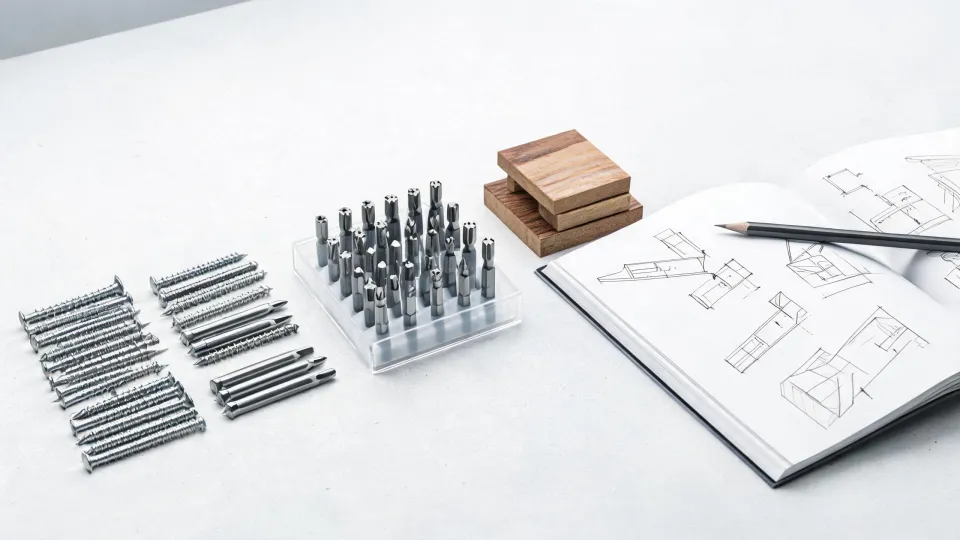
Why a purchasing admin started caring about screw heads
I'm not an engineer. I'm the office administrator for a 40-person construction company. I manage all purchasing—roughly $85,000 annually across about 7 vendors—and I report to both operations and finance. Fasteners are a significant chunk of that spend, and they're the easiest category to overlook. Until they cause a problem.
In 2023, I ordered a batch of structural screws for a decking project based on the lowest unit price. The screws themselves weren't the issue. The drive head didn't match the bits our crew already had. Installation slowed down, I had to rush-order replacement bits, and the final invoice for that project came in roughly $600 over what we'd quoted. That $600 was nowhere on any price sheet.
That's when I started paying attention to things like T-20+ wafer head construction screws and what actually makes a SPAX screw different from what we'd been buying.
This article is a comparison. Not a spec sheet—I'll leave that to the engineers—but a procurement-side breakdown of how SPAX screws stack up against the standard fasteners we've used for years. I'm comparing across four dimensions: drive system, material compatibility, sizing, and total cost. Those are the things that actually affect my orders, my budget, and whether my crew is calling me at 7 AM with a problem.
Drive system: T-20+ wafer head vs. standard Phillips
Here's the simplest answer to "what is a SPAX screw": it's a brand built around a different drive philosophy. SPAX construction screws typically use a Torx-style or their proprietary T-20+ wafer head drive instead of a standard Phillips cross. The head is wider, the contact area is larger, and the bit engagement is deeper.
What that means on-site is fewer cam-outs. If you've ever watched someone drive a long screw into hardwood with a Phillips head, you've seen the bit slip—it jumps out of the head, chews up the recess, and sometimes strips it entirely. That's a dead screw. And a dead screw means a delay, a replacement, and sometimes a damaged surface.
Does the T-20+ drive eliminate that problem completely? No. I've seen cam-outs with SPAX too. But the frequency is noticeably lower, based on what our crew foremen have reported. (Should mention: I don't have lab data on this—just consistent feedback from the people actually using them.)
For procurement, the comparison breaks down like this:
- Standard Phillips: Bits are cheap and universally available. But the higher cam-out rate means more wasted screws, more time, and more surface damage—especially on hard materials.
- T-20+ / Torx drive: Requires a specific bit type, which adds a line item to your order. But the reduced cam-out rate lowers rework and improves crew satisfaction.
The numbers said go with Phillips because the bits are cheaper and we already had them in stock. My gut said that cheapness was a false economy. I went with my gut and test-ordered the SPAX Torx system. Turned out the gut call was right—the labor savings from fewer cam-outs more than covered the bit cost within the first project.
Material compatibility: multi-surface vs. single-purpose
Standard wood screws are designed for specific materials. You've got your softwood screws, your hardwood screws, your MDF screws, your decking screws. Each one is optimized for a particular substrate, and using the wrong one means either poor holding power or a screw that won't drive cleanly.
SPAX's angle here is broader material versatility. Their construction screw line is designed to work across a wider range—wood, composite decking, MDF, and some structural applications—without needing a different SKU for every material type.
From a purchasing perspective, this matters more than it might seem. Every additional SKU in our ordering system is another opportunity for a mistake. A framer needs screws for a composite deck repair, but I've only got the hardwood box in stock. Do I order more? Do I substitute? Every one of those decisions costs time.
I'm not going to claim SPAX screws work in every material under every condition—that's not how fasteners work. But the wider usable range does reduce the number of SKUs we need to track and the number of calls I get asking "did you order the right kind?"
That said, if your operation works with one material type almost exclusively, the versatility advantage shrinks. In that case, a standard screw optimized for that single material can be just as effective and simpler to inventory.
SPAX screw sizes: getting the spec right
Size selection is where I've made the most costly mistakes—and I don't think I'm alone in that.
SPAX screw sizes follow the same basic logic as standard fasteners: length, diameter, head type, and drive type. The difference is that SPAX has more head and drive variations within their catalog, which means more ways to order the wrong thing if you're not careful.
My rule now: I don't guess. I ask the crew foreman for the exact spec—length, gauge, head type, drive—and I order precisely that. When I first started buying SPAX, I tried to translate from the standard wood screws we'd been using. I figured a #8 x 2" was a #8 x 2" no matter what brand. The head type was wrong. The screws worked, technically, but the crew's existing bits didn't engage properly, and everyone was frustrated for a week while I sorted it out.
One more thing that I didn't factor in early on: storage and organization. If you're switching from a bulk box of standard screws to branded SPAX packaging, you might want a dedicated tool box to keep sizes separated. A 16-inch tool box price ranges anywhere from $15 to $60 depending on material and brand. It's not a dealbreaker, but it's a cost I didn't plan for the first time around.
The takeaway: don't self-diagnose screw sizes based on what you used before. Ask the person using them. Then order exactly that.
Total cost: the part that isn't on the quote
This is where my purchasing philosophy kicks in. I've learned to ask "what's not included" before I ask "what's the price."
A vendor who lists every fee upfront—even if the total looks higher—usually costs less in the end than the one who quotes a low unit price and then adds shipping, rush fees, minimum order surcharges, and return costs on the back end.
I lived through that in 2021. A supplier quoted a per-unit price that was 20% below our regular source. I placed the order. Then came the freight charge. Then the "expedited handling" fee because it was a bulk order. Then the restocking fee when three boxes arrived with the wrong head type. The final cost was over 30% above the original quote. I looked bad to my VP, who had approved the switch based on my recommendation.
With SPAX, the unit cost isn't the lowest on the market. I'm not going to pretend it is. But the calculation I run now includes: drive-system rework reduction, material compatibility (fewer SKUs = fewer mistakes), clear sizing documentation, and—importantly—vendors who provide full cost breakdowns before I commit.
That last part is what I care about most. Transparency. A supplier who hides costs to win the quote is a supplier who'll cost me more down the line. The one who says "here's everything, including the boring fees" is the one I trust with repeat orders.
So which one should you buy?
There's no universal answer, and anyone who gives you one is oversimplifying. But here's my practical breakdown based on five years of managing these orders:
Standard fasteners make sense when:
- Your projects use one or two material types consistently
- Your crew already has compatible bits and is experienced with the drive system
- Your order volumes are low and variety isn't a concern
- You need something available at any local supplier on short notice
SPAX screws make sense when:
- Your projects span multiple materials and you want to reduce SKUs
- Rework from cam-outs or stripping is a recurring cost you're trying to control
- Your crew is open to adopting a different drive system (and you're willing to supply the right bits)
- You value vendors who provide full pricing transparency over ones who quote the lowest unit price
If you're on the fence—which I was for about three months—order a small batch. Have your crew use them on a real project. Compare the rework. Then decide.
The spreadsheet will only tell you so much. Sometimes the $600 you don't spend on rework matters more than the 12 cents you save per screw.

Leila Farzan
Leila Farzan is an independent welding, abrasives, and cutting accessories analyst covering welders, electrodes, wire, grinding wheels, flap discs, cutting discs, drill bits, saw blades, hole saws, and router bits. She references ISO 525 abrasive-product dimensions and ISO 9606-1 welding qualification concepts while examining wheel speed, grit, bond, electrode class, duty cycle, kerf, tooth geometry, and material compatibility. Her guides help fabricators choose consumables, control process risk, and compare cut or weld quality.