SPAX Multi-Material Screws and MDF: A Hard Lesson in Why the Right Screw Is Still a System Decision
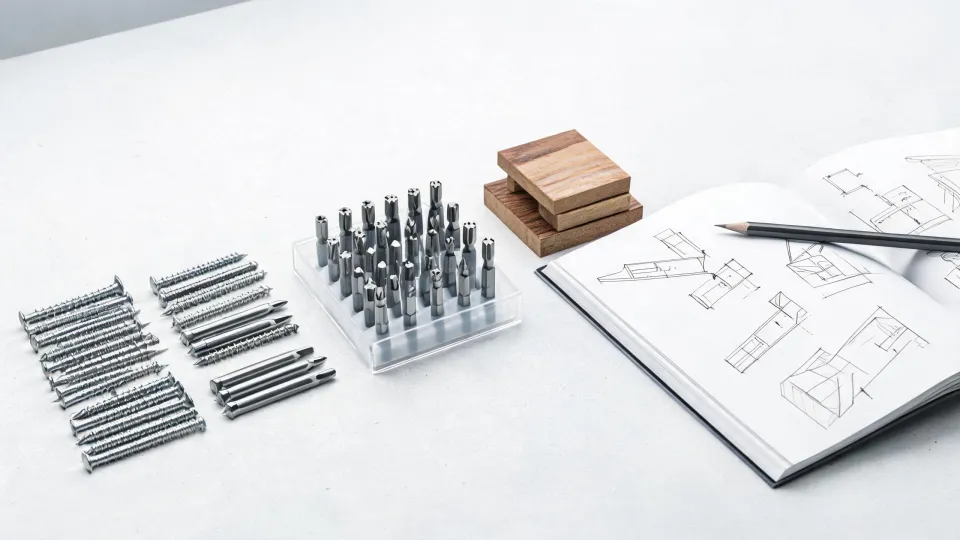
If you've ever driven a SPAX multi-material construction screw into the edge of an MDF board and watched a hairline crack run out before the screw even seated, you know the feeling. It's not just a bad day. It's a waste of money.
I know, because I did it on a bigger scale than I'd like to admit.
The Surface Problem: Great Screws, Splitting Boards
I bought my first box of SPAX multi-material construction screws for an MDF shelving project. The box said multi-material, and I took that as a license. I figured: it's a construction screw, it has a Torx drive, it's corrosion resistant, so it must be compatible with MDF. What could go wrong?
Plenty. The first shelf board cracked at the edge. The second cracked near a pre-drilled hole. The third didn't look right—the screw head sat slightly deeper on one side. I finished the job using parts from a spare board and a lot of wood glue.
In my opinion, that's the typical experience when someone reaches for a strong screw and forgets that MDF is not wood.
The Deeper Problem: MDF Is Not Wood
This is where it gets uncomfortable. The screw wasn't the problem. My mental model was.
Wood has grain. It can split, but it also has structure that absorbs some of the stress around a screw. MDF is made from wood fibers mixed with resin and pressed into panels. It has no grain. It has almost no give. When you drive a coarse screw into the edge of MDF without a proper pilot hole, the thread volume has to displace somewhere. In a piece of dimensional lumber, that stress gets absorbed. In MDF, it cracks.
To be fair, a standard SPAX multi-material construction screw can work well in MDF for many applications. But can work is not the same as always the right choice. The brand even lists dedicated SPAX screws for MDF, and the reason is geometry, not marketing. The shaft, the thread spacing, and the head design are tuned for wood fiberboard. That distinction matters when you're working near edges or in thin panels.
MDF panels are usually manufactured to ANSI A208.2, so the material's behavior is fairly predictable. And according to SPAX's published installation guidance (accessed May 2026), pre-drilling is recommended for many wood-based materials. I now treat that as a requirement, not a suggestion.
The Hidden Cost: More Than a Wasted Board
Let me give you a specific number. In 2022, I built a set of shelving units for my shop out of 3/4-inch MDF. I did not pre-drill the edge joints. I was in a hurry, I had a new 232-piece mechanics tool set, and I wanted to get the thing built.
By the time I finished, 14 of the 32 edge joints had cracked. The replacement boards cost $212. The extra labor ate a full Saturday. I still keep a photo on my phone as a reminder of the difference between looking right and being right.
That's the small version. In a commercial setting, those costs multiply. You replace material, you reschedule the crew, you explain to a client why the schedule slipped. And with structural fasteners, the cost can be worse than money. If you use a screw in a load-bearing connection without checking the manufacturer's published ratings, you're risking more than a shelf.
I get why people skip the reading. It doesn't feel productive. But the hidden task in every fastener project is not tightening the screw; it's understanding the material, the load, and the tool.
Why This Reminds Me of Sizing a Centrifugal Pump
Here's a sentence I never expected to write in an article about screws: choosing a fastener is a lot like learning how to size a centrifugal pump.
When someone asks me how to size a centrifugal pump, the first response is always two questions: what flow rate do you need, and what total dynamic head are you fighting? If you don't know the system curve, a pump model is just a guess. Install too big a pump and you run off its best efficiency point, waste energy, and sometimes make the problem worse.
A screw is no different. Strongest screw you've got is a useless specification. What matters is the system: material thickness, edge distance, load type, moisture exposure, and drive tool. Change any one of those, and the right screw can change with it.
That's why professionals don't grab just a screw. They grab the screw that belongs in that particular system.
The Tool Question: A Box of Sockets Won't Save You
I'm a fan of good tools. My 232-piece mechanics tool set has bailed me out more times than I can count. But owning the box is not the same as owning the knowledge.
You would not use garden hand tools to service an engine. In the same way, you should not use a random bit from a socket set to drive a SPAX screw without checking that it fits the Torx recess and the driver is set for the material. A worn bit will cam out under load. Too much torque can snap the head or strip the MDF.
So when I see a contractor with a 232-piece mechanics tool set, I don't immediately think great. I think: does the right bit still fit in the right driver with the right setting? Sorry, but that's the kind of question you start asking after a $212 mistake.
The Short Fix (Yes, It's Short)
If you're doing MDF work right now, here's the checklist I use:
- Check the manufacturer's technical data sheet for the exact screw you're using. If you're using SPAX multi-material construction screws, confirm the recommended pilot hole size and depth.
- Pre-drill edge joints in MDF. This is not negotiable if you want clean edges.
- Use the correct driver bit. It should seat into the Torx recess without wobble.
- Choose the right tool. A 232-piece mechanics tool set is a great thing to own, but the bit needs to go in a driver with controlled speed and torque.
- Consider a dedicated SPAX screw for MDF for edge- and thin-panel work.
- Think about the load and the material before you think about the screw. Same process as pump sizing: define the system, then choose the component.
Bottom line: I use SPAX multi-material construction screws on a lot of jobs. They're well-made, and the drive system makes a real difference in hand. But multi-material is not a magic word. MDF is its own animal, and if you don't treat it that way, the screw won't save you.
Take it from someone who learned the hard way: the most expensive mistake in a project isn't the wrong screw. It's the confidence that the screw alone is enough.

Maren Jorgensen
Maren Jorgensen is an independent hand tool and torque applications analyst covering wrenches, pliers, screwdrivers, hammers, sockets, ratchets, hex keys, and tool sets. She applies ISO 6789-1 torque-tool conformance principles while examining jaw capacity, leverage, fastener engagement, torque range, accuracy, handle geometry, and material hardness. Her practical guides help tradespeople and procurement teams select suitable tools, plan controlled tightening, and compare durability without relying on brand reputation alone.