Hanging Trim Without a Nail Gun: Why SPAX Concrete Screws Are the Right Call on a Deadline
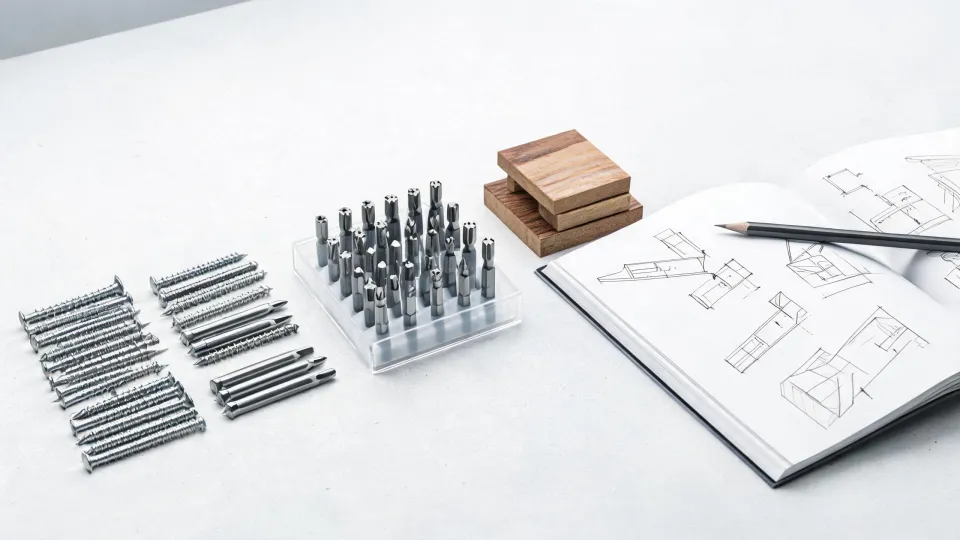
Let me say something that might surprise you: if you're hanging trim without a nail gun, you're not at a disadvantage. Not if you have the right screws in hand. I've reached this conclusion after coordinating more than 200 rush jobs over the last eight years, and there are situations where I now reach for a drill over a nailer without hesitation.
I understand the appeal of a brad nailer. It's fast, it's clean, and it's what every installation guide recommends. But those guides assume a wood substrate. A lot of commercial work doesn't involve a wood substrate. And when you've got an inspector scheduled for 8 AM and a storefront full of uninstalled trim, the gap between what the guides assume and what the job requires can get expensive real fast.
This isn't theory. Let me show you what I mean.
The Storefront Job That Rewired My Thinking
In March 2024, a project manager called me about a storefront renovation that was scheduled for final inspection the next morning. The trim around four door frames had just arrived after a shipping mix-up—the manufacturer had sent the wrong profile the first time around. The crew was staring at the correct pieces, a pile of MDF trim, and a clock that wasn't going to stop.
Here's where the plan started to fall apart: the door frames were set in concrete block walls, and the crew had brought nail guns. They'd assumed they'd be fastening into wood framing. Concrete block doesn't care about your assumptions. There is no nail that anchors confidently into solid masonry—a nail gun isn't a magic wand, it's just a tool that pushes a fastener into whatever is behind the surface. If what's behind the surface is concrete block, the nail gun doesn't help you at all.
Standing there, with the GC's patience running thin, I remembered the box of SPAX concrete screws in my truck. They'd been purchased for an earlier part of the project, and the green SPAX logo on the box caught my eye for a different reason. What if we used them to hang the trim?
I grabbed a scrap piece of MDF, held it against the block wall, and drove one in. It bit cleanly. I torqued it down. It held. It wasn't going anywhere.
We split into two crews—one drilling and countersinking, one driving screws—and finished all four door frames in about three hours. The inspector walked through the next morning and signed off without a single comment about the fasteners.
Everything I'd read about trim installation said you need a brad nailer for speed and precision. In practice, I found that a properly selected screw is faster to trust and honestly better in that context. The conventional wisdom was built for a world that didn't include concrete-block construction.
Why SPAX Concrete Screws Are Built for This
From the outside, it looks like hanging trim is about having the right power tool, and the conversation usually ends there. The reality: the fastener is the real decision. The tool just delivers it.
Here's why SPAX concrete screws work so well in this application:
- Self-tapping threads. The screw cuts its own channel into the masonry, creating mechanical interlock along the full length of the fastener. That's a completely different mechanism from a nail, which relies on friction and substrate density. In concrete, there's no contest.
- Torx drive system. The Torx profile transfers torque cleanly without stripping or cam-out. When you're on a ladder, balancing trim with one hand and driving a screw with the other, you don't want a bit slipping. This matters more than you'd think.
- No wall anchors. With a regular screw, you'd need to install an anchor first. That's extra drilling, extra parts, extra trips to the truck. SPAX concrete screws remove that step entirely—which is a huge advantage when the clock is running.
These are the details that matter at hour 12 of an 18-hour day. When you're working against a deadline, you want fewer steps, not more.
The Real Cost of Sticking to the Plan
Here's a number that stuck with me: $1,800. That's the penalty a general contractor paid because he refused to use screws on a masonry trim job.
In January 2025, on a different project, the exact situation came up again. Trim needed to go onto concrete masonry units, and the crew wanted to wait for a nail gun to become available. I suggested SPAX concrete screws—I even had a box in my vehicle. The GC was insistent: "We're a professional crew. We use a nailing system for trim."
I let it go. Not my call. They waited overnight, brought a nail gun to a concrete job, and discovered what should have been obvious: the nail gun was useless on that substrate. They ended up buying adhesive and anchor screws anyway to secure the trim. The inspection window was missed, the certificate of occupancy was pushed back a week, and the GC wrote a very expensive check.
The nail gun never drove a single finishing nail into that concrete block. The crew ended up using a solution that was essentially the one I'd suggested the night before—at higher cost, under more pressure.
The lesson I've carried from that project: the most expensive thing on a deadline job is a plan you refuse to change. The certainty of completion is worth more than the tool you originally planned to use.
Objections, Addressed
I hear the same counterarguments every time this topic comes up. Let me respond to the three most common ones.
"Screws are slower than nails." At the individual fastener level, yes. But that comparison ignores everything around it. A screw is a complete fastening system in one step—no pilot hole in most materials, no anchors, no compressor setup, no jam clears. With a cordless drill and the right bit, the speed difference is maybe ten seconds per fastener. You get that time back when you don't have to fix a popped nail or re-hang split trim.
"You can see the screw heads." Not if they're properly countersunk. A quick pass with spackle and paint makes them invisible. I've done this on visible trim work and you'd never know there's a screw anywhere in the wall.
"Codes require nails for trim." In most jurisdictions, building codes are performance-based when it comes to non-structural trim. The requirement is that the trim be securely fastened—not that a particular fastener be used. When the substrate is concrete or masonry, a screw is actually the more appropriate mechanical fastener. Check your local code amendments to be sure, but don't assume nails are a code requirement.
Now, before you think I'm anti-nail-gun: I'm not. I own one, I use it, and on wood-to-wood trim work, a nailer is hard to beat for speed. I am not saying nail guns are useless. I'm saying they're the wrong tool for concrete and masonry—and the faster you accept that, the less it costs you.
My Bottom Line
If you found this article by searching "how to hang trim without a nail gun," here's the short answer: stop worrying about the tool and start focusing on the fastener. SPAX concrete screws have gotten me out of more deadline jams than any other product I carry, and the green SPAX logo on the box has become a symbol I trust when the pressure is on.
You don't need a tool rental. You don't need to delay the schedule. You need a drill, the right screw, and the confidence that it will hold. The trim on that March 2024 storefront is still there today. Not one fastener has loosened. And the inspector never had a question.
Your deadline doesn't care about your preferred tool. It cares about the result. Give it a result it can't argue with.

Maren Jorgensen
Maren Jorgensen is an independent hand tool and torque applications analyst covering wrenches, pliers, screwdrivers, hammers, sockets, ratchets, hex keys, and tool sets. She applies ISO 6789-1 torque-tool conformance principles while examining jaw capacity, leverage, fastener engagement, torque range, accuracy, handle geometry, and material hardness. Her practical guides help tradespeople and procurement teams select suitable tools, plan controlled tightening, and compare durability without relying on brand reputation alone.