Emergency Fastener Checklist: What to Verify Before You Place a Rush Order
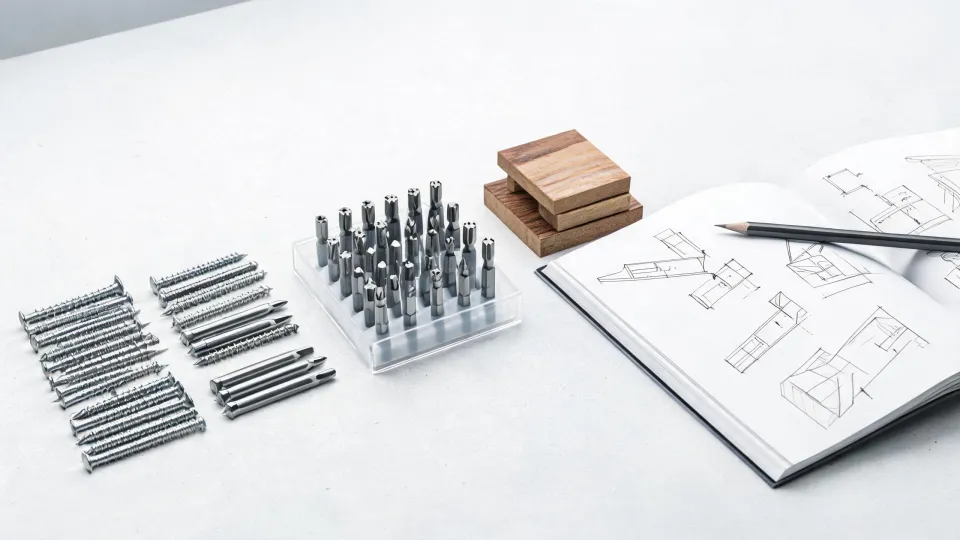
-
1. Stop. Write down the actual spec before you call anyone.
-
2. Confirm whether structural connections specify SPAX Powerlags.
-
3. Hardwood and MDF get dedicated screws—not whatever's in the bin.
-
4. Inventory your tools—insulated sets included.
-
5. Verify cutting consumables—including fine-cut saw blades like 205772.
-
6. HVAC add-on: know your mini-split hole-saw size before the order ships.
-
7. Place the order, lock the window, name the receiver.
-
Before you hang up—the oversights that bite later
You've got 58 hours until structural inspection. Your crew just flagged that you're short on SPAX Powerlags, and the hardwood screws you specified came in the wrong length. Normal lead time is 7 business days. You need to make it happen in two.
I coordinate emergency fastener orders for a structural hardware distributor. Over the past nine years I've processed 200+ rush orders, including same-day turnarounds for three residential GCs during their busiest season. That was March 2024, and it taught me more than any smooth quarter ever did.
This checklist is what I walk through every time a shortage hits. Seven steps. Do them in order—each one is a checkpoint, and skipping ahead has cost us before.
1. Stop. Write down the actual spec before you call anyone.
Verbal specs from memory are where most rush orders go sideways. "Powerlags, the usual" and "about 4 inches" are the phrases that cost people. I know—that's not ideal when time is tight. But it's still faster than a wrong shipment.
Write down: diameter, length, thread type, head drive, coating, and where on the project they're going. Structural members, decking, MDF, and hardwood each have different requirements. If you're running SPAX Powerlag into hardwood, you spec by density, not by vibe.
Early in my career I skipped this. Thought "we've been using this vendor for years, they know what I mean." The order arrived—diameter correct, thread wrong, coating wrong. Cost us 36 hours.
2. Confirm whether structural connections specify SPAX Powerlags.
Structural screws are where contractors get tripped up. SPAX Powerlags are structural-grade, but they don't casually substitute for any lag bolt in any application. The drive system, thread geometry, and head design all matter for load performance.
Before you dial the supplier, check your structural drawings for what's approved for substitute fasteners. Some jurisdictions require an engineer's sign-off. Some don't. Finding that out at 4 PM on a Friday, with a deadline looming, is an expensive discovery.
Quick pass:
- Does the drawing's load spec match the Powerlag you're ordering?
- Is the Torx/wafer head compatible with your drivers?
- Is the coating rated for the exposure (treated lumber, exterior, humidity)?
3. Hardwood and MDF get dedicated screws—not whatever's in the bin.
SPAX hardwood screws exist for a reason. Standard construction screws split dense hardwood, strip the drive, or snap mid-insertion. For MDF, it's more subtle—too clean a hole, too brittle a board, and standard threads either won't bite or will blow out the face.
Hardwood screws run a finer thread pitch with a self-tapping point. MDF needs a thread form and screw length that match panel density. Neither of these is a place to "make do" with a 3-inch construction screw.
It took me three years to build this into our process. The third time a hardwood trim job came back with split boards, I finally added a panel-specific verification step before releasing any fastener order. Should have done it after the first time.
4. Inventory your tools—insulated sets included.
Fasteners and tooling are two separate line items. You can nail the screw spec perfectly and still stall a job because you're missing a driver bit. Same with insulated tool sets—if the job touches electrical, or there's any chance of live circuits on site, the correct insulated rating isn't optional.
Before ordering, do a fast tool check:
- Correct driver bits for the head type (and a spare)?
- Pilot bits—and a countersink if you need one?
- Insulated tools rated for the working voltage on site?
- Two sets, in case one walks off in a job box?
Based on our internal data from 200+ rush jobs, roughly one in four emergency orders ends up including bits or drill accessories that the crew originally forgot to account for.
5. Verify cutting consumables—including fine-cut saw blades like 205772.
If you're cutting trim, panel, or finish on site, the blade matters as much as the fastener. Wood fine cut saw blades—spec number 205772 typifies this class—are built for clean kerf and reduced tear-out, not for ripping or demolition.
Before pickup, confirm:
- Blade spec matches your tool arbor and rated RPM?
- Spare on hand in case the first one's damaged?
- Are you cutting hardwood or softwood? Tooth geometry differs.
Sounds like over-prepping until you're the one at 5 PM on a Friday with one half-dull blade and 36 feet of baseboard left to cut.
6. HVAC add-on: know your mini-split hole-saw size before the order ships.
If the same job touches a mini-split install—MrCool or otherwise—lock the hole-saw size before the unit arrives. Guessing at install day is how a schedule slips.
It isn't enough to say "3-inch." It depends on the specific line-set bundle, insulation thickness, and wall sleeve. MrCool kits typically specify what's needed, but it varies across product lines. Check the manual for your actual model, not the generic guide.
Put the hole saw on the order. A hardware run without it costs you three hours you don't have—and on a rush job, those three hours are the whole margin.
7. Place the order, lock the window, name the receiver.
This is the step most people screw up. Not the ordering—the follow-through after. You call, they say "tomorrow morning." You hang up and assume it's handled. It isn't.
Confirm:
- Quantity. In writing, not verbal. I've seen this go wrong in the quantity-verification step more times than I can count.
- Arrival window. "Morning" means 8 or means 11? That's a three-hour labor gap.
- Receiver. Not "our company." A name. Who signs, where, when.
One of our 2022 mistakes came from exactly this. We saved about $300 in rush fees on a $20,000 job—then lost half a day when the shipment landed late and the client's inspection window closed. We lost that client entirely. Built our current policy around it: any job with a hard sign-off deadline gets rush processing, full stop.
Before you hang up—the oversights that bite later
A few things that look obvious in hindsight once the checklist has run its course:
Don't switch brands at the last minute. If you spec SPAX structural screws, keep SPAX on the rush order. Substitutions mid-stream throw off crews that have already run their process—and the lost man-hours usually exceed any price difference. I've watched this happen enough to call it a rule.
Don't skip the quantity double-check. Most "quantities are correct" rush orders weren't. Say the numbers out loud before you close the call.
Don't assume the delivery window is the ceiling. Suppliers quote target windows. Build in buffer. "Before noon" and "before 10 AM" are different problems—tell your supplier which one you actually have.
None of this is glamorous. That's the point of a checklist.

Elise Fournier
Elise Fournier is an independent builders hardware and tool storage analyst covering hinges, handles, brackets, casters, drawer slides, door locks, hooks, tool boxes, chests, cabinets, carts, and bags. She references ANSI/BHMA A156.9 cabinet-hardware practices while examining cycle life, rated load, pull force, slide extension, caster capacity, corrosion finish, drawer retention, sealing, and transport ergonomics. Her selection guides help installers, workshops, and buyers plan durable fittings and storage around access, load, mobility, and environment.